Sunday, 30 May 2010

She Sells Seashells On The Seashore...

REVIEW: Remarkable Creatures by Tracy Chevalier
Paperback: 352 pages
Publisher: Harper (1 April 2010)
ISBN-10: 0007178387
ISBN-13: 978-0007178384
Copy: Bought in local bookshop

On the back of the book:
On a windswept English beach in the early 19th century, two women make discoveries that change the world. And in doing so find friendship, pride – and trouble.

From the moment she’s struck by lightning as a baby, it is clear Mary Anning is different. Her discovery of strange fossilized creatures in the cliffs of Lyme Regis sets the world alight. But Mary must face powerful prejudice from a male scientific establishment, not to mention vicious gossip and the heartbreak of forbidden love. The – in prickly, clever Elizabeth Philpot, a fossil-obsessed middle-class spinster – she finds a champion, and a rival. Despite their differences in class and age, Mary and Elizabeth’s loyalty and passion for the truth must win out…


Remarkable Creatures is a fictionalised account of the life of Mary Anning (1799 – 1847), a woman from Lyme Regis whose fossil hunting skills produced specimens that would revolutionise the world of science and question the religious view of creation itself. Now a highly respected figure in Palaeontology, she never received the full recognition she deserved for her discoveries in her lifetime. The Natural History Museum in London displays many of the fossils she uncovered in the cliffs around Lyme Regis, now correctly attributed to her.

The development of Geology as a science is an integral part of the story in Remarkable Creatures. Many distinguished scholars owe a considerable debt to Mary Anning as she provided such luminaries as Henry De La Beche, Louis Agassiz, William Buckland and William Conybeare with the fossils on which they built their scientific reputations.
(C) Natural History Museum

The story focuses on the friendship between Mary and Elizabeth Philpot (1780 – 1857), how they met when Mary was still a child and how their shared love of fossils created a strong bond between the pair. Mary is the girl in the tongue-twister nursery rhyme “She sells seashells…”. Elizabeth Philpot was something of a mentor to Mary, encouraging her to read about geology and to follow a scientific method in recording and documenting her finds. A strong theme throughout the book is how, because of their gender, their lives were severely restricted by the social mores of their era.

The narration of events switches between Mary and Elizabeth, told in the first person. For me, this worked well as we get to see both sides of the friendship and gain insight into each woman’s life. Despite the difference in age and class, they eventually found a balance with each other. Elizabeth, a middle-class, middle-aged spinster, sent away to live with her 2 unmarried sisters by her married brother, is the dominant voice and it is through her we see the constraints placed on women, especially unmarried ones, in this period of history.


“Mary Anning and I are hunting fossils on the beach, she her creatures, I my fish. Our eyes are fastened to the sand and rocks as we make our way along the shore at different paces, first one in front, then the other. Mary stops to split open a nodule and find what may be lodged within. I dig through clay, searching for something new and miraculous. We say very little, for we do not need to. We are silent together, each in her own world, knowing the other is just at her back.”


While I thoroughly enjoyed reading Remarkable Creatures, I was irritated by the romance between Mary and Colonel Birch. It seemed contrived to me, and not necessarily in keeping with the rest of the book. That aside, the detail of everyday life in early 19th century England showed Tracy Chevalier’s commitment to research and it made the personalities shine through. Mary and Elizabeth are strong, likeable characters who make the most of the world in which they find themselves. Despite differing levels of education, Mary being mainly self-taught, the women have keen intellects and questioning minds that try to make sense of Mary’s finds in the context of their religious teachings and the nature of God. This was a period where the Biblical Creation myth was largely unquestioned until the discoveries by Mary Anning and others. I enjoyed this side of the book knowing that ideas that were discussed contributed to Charles Darwin’s thinking on evolution.

Sunday, 16 May 2010

THE BOOK HABITS MEME

I first read about the book habits meme on Amanda’s blog at Floor to Ceiling Books where she states
I have seen this on Genre Reader and the original post is hosted on The World in the Satin Bag.
Having read (and enjoyed) Amanda’s answers I decided to do this myself, so here goes…

Do you snack while you read? If so, favourite reading snack:
Yes, I snack while reading. Often it is chocolate or sweets, but nuts (raw, honey-roasted, salted, whatever), crisps, rice cakes, or biscuits can also help the reading process. A sign of a really engrossing book is that the snacks do not get eaten!

What is your favourite drink while reading?
Generally it is water, I drink a lot of water! Sometimes I’ll make a cup of herbal tea or mug of hot chocolate, but water is the default.

Do you tend to mark your books as you read, or does the idea of writing in books horrify you?
I rarely write notes in a fiction book but I have come to rely on post-its when reading a book for review. I use little coloured index tabs to flag interesting quotes etc.
Text books, however, are often heavily marked with highlighter pen, a habit picked up many years ago when at college. Now the only text books I read are on computing (Java anyone?) and these tend to be a riot of fluorescent ink.

How do you keep your place while reading a book? Bookmark? Dog-ears? Laying the book flat open?
I generally use bookmarks, mostly those free advertising ones available at the cash desk in bookshops. If I haven’t got one to hand, I’ll use postcards, train tickets, receipts or anything I find in the black hole that is my handbag! My last resort is to dog-ear the corner, though I will use the cover flap of a hardback to keep my place. The only time I lay a book flat open is when I’m reading in bed… I often wake up in the morning to find the light still on and my book lying face down beside me.

Fiction, nonfiction, or both?
Predominantly fiction. But I read popular science, environment/green politics, history, rock biographies, new age/spirituality/Buddhism too. I’m eclectic! I’d say 5 fiction books to 1 non-fiction.

Are you a person who tends to read to the end of a chapter, or can you stop anywhere?
I try to stop at the end of a chapter or section, but this doesn’t always work out. I can pick up from where I left off though, even in the middle of a paragraph.

Are you the type of person to throw a book across the room or on the floor if the author irritates you?
No, never. I will abandon a book if I don’t like it though. I have no qualms about NOT finishing a book… life is too short to waste time reading something you dislike!

If you come across an unfamiliar word, do you stop and look it up right away?
It is rare that I find an unfamiliar word, and I can generally work out the meaning from the context. It is only with recent technological advances i.e. my iPhone that I have the ability to look up a word when reading on the move, so it’s something I learned to deal with years ago!

What are you currently reading?
  • Angelology by Danielle Trussoni
  • Remarkable Creatures by Tracy Chevalier (book club)
  • The Mammoth Book of SF Alternate Histories ed. Ian Watson and Ian Whates
  • Dante’s Journey by J.C.Marino
What is the last book you bought?
All in one order from Amazon:
  • The Photographer’s Eye by Michael Freeman
  • The Blade Itself by Joe Abercrombie
  • Apartment 16 by Adam Neville
  • The Marks of Cain by Tom Knox
  • Remarkable Creatures by Tracy Chevalier
  • The Magician’s Apprentice by Trudi Canavan
Are you the type of person that reads one book at a time, or can you read more than one?
I read more than one at a time. There’s one in my handbag for train/tube trips or when an opportunity presents itself. Another is for bedtime reading and then I’ll allocate time for specific books, usually those I am going to review.

Do you have a favourite time/place to read?
Anytime, any place, anywhere! If I have a spare few minutes, I’ll fill that time by reading. But reading in bed is my favourite.

Do you prefer series books or stand alones?
Both! But I can get impatient for the next in a series to be published.

Is there a specific book or author you find yourself recommending over and over?
Yes, there are several. Stephen Baxter, Jacqueline Carey, Mark Charan Newton, Jaine Fenn to name a few.

How do you organize your books?(by genre, title, author’s last name, etc.)
By size, then author’s name and publication date. I have different genres in separate locations…

Thursday, 15 April 2010

Not all books are fantasy...

Much as I love speculative fiction, there is another genre that will always attract me and that is Rock Autobiography/Biography. I am currently reading Just Kids: From Brooklyn to the Chelsea Hotel, a Life of Art and Friendship by Patti Smith, the story of her relationship with Robert Mapplethorpe and their lives in 70's New York and beyond. I have long been enthralled by Patti Smith and so far I have not been disappointed in her writing.

There are some classic rock biographies, one which got me into the genre was No-one Gets Out Of Here Alive by Jerry Hopkins and Daniel Sugerman. The life story of Jim Morrison, poet, shaman and outrageous lead singer of The Doors, did not have a happy ending, but man, that guy lived! The life of Bob Marley was protrayed in the excellent Catch A Fire by Timothy White. Other recommended reads are:
  • Sweet Scars of Paradise: The Life and Times of Janis Joplin by Alice Echols
  • Scar Tissue: The Autobiography by Anthony Kiedis and Larry Sloman
  • White Line Fever: Lemmy - The Autobiography by Lemmy Kilmister
  • The Dirt - Motley Crue: Confessions of the World's Most Notorious Rock Band by Neil Strauss, Tommy Lee, Vince Neil, and Mick Mars
  • Slash: The Autobiography by Slash and Anthony Bozza
  • Bit of a Blur by Alex James
  • When Giants Walked the Earth: A Biography of Led Zeppelin by Mick Wall
  • Hammer of the Gods: Led Zeppelin Unauthorised by Stephen Davis
  • Sex and Drugs and Rock 'n' Roll: The Life of Ian Dury by Richard Balls
  • Long Hard Road Out of Hell by Marilyn Manson and Neil Strauss
So what is the attraction of a rock biography? Personally speaking, it is to understand the person behind the music, away from the headlines and scandals. What drives their creativity and how they deal with the excesses of the rock business fascinates me, especially as so many are tortured souls in one way or another. The hedonistic lifestyle that surrounds rock superstars destroys that it claims to worship, and is a monster in its own right. But the music always triumphs in the end even if the artist does not survive.

There are some quality rock writers around today, many of whom cut their teeth on UK music weeklies like the NME, Melody Maker or Sounds. Collections of their writings are available and provide a wealth of interviews and articles on the music of the day. Some favourites are listed below:
  • Shots from the Hip (Penguin originals) by Charles Shaar Murray
  • The Dark Stuff: Selected Writings on Rock Music 1972-1993 by Nick Kent
  • England's Dreaming by Jon Savage
  • The North Will Rise Again: Manchester Music City 1976-1996 by John Robb
Many music journalists go on to pen biographies, and I have found the quality of the writing to be of a consistently high standard. A good biography, especially on a controversial figure, can add dimension to the music itself. After reading Torn Apart: The Life of Ian Curtis by Mick Middles and Lindsay Reade I gained a deeper appreciation of Joy Division lyrics and the darkness that enveloped the singer.

So, if you like music and want a little break from fiction, check out the music section in your local bookstore. You might be surprised at what you find there.

Wednesday, 14 April 2010

Are bookstores killing themselves?

There is an excellent article in the Guardian bookblogs section on this year's Hugo Award nominations "Hugo awards 2010: the shortlist"
China MiƩville excepted, the finalists for this year's best SF novel have one thing in common: mainstream invisibility
Sadly this statement is very true. Where are the displays containing the 6 shortlisted books in mainstream bookstores? Most booksellers highlight mainstream awards such as the Man Booker or Orange Prize for Fiction with a showcase of the nominees. Even the Richard and Judy Book Club (now The TV Book Club on Channel 4) gets pride of place positioning in Waterstones and WHSmiths. Sadly, with the demise of Borders, the mainstream has a stranglehold on book selling in the UK, leaving little room for 'outsiders' such as the Hugo Awards or the Arthur C Clarke's. Is this symptomatic of the disdain in which Science Fiction and Fantasy, as a genre, is held? Probably, yet, given the slightly obsessive book-buying nature of many SFF fans, are the big UK chains losing a potentially lucrative market by ignoring major genre awards?

Well, if I am indicative of an average SFF fan, the answer is a resounding YES! I spend most of my monthly book-buying budget online now. I can't remember the last time I ventured into my local Waterstones, mainly because whoever is in charge of the SFF section just does not appear to know the genre particularly well. The table-top display is OK, but if I understand correctly [see Mark Charan Newton's blog for more discussion on book selling techniques], this space is paid for by publishers wanting to promote their latest releases. The shelving, on the other hand, tends to be a mixture of TV tie-ins, urban fantasy, paranormal romance and 'standards' such as Pratchett, Rankin, Jordan, Eddings and Gemmell. Very similar to what WHSmiths offer in their larger stores. No innovative or cutting-edge titles to be seen. Not even any China MiƩville...

I choose to shop online because of the range of authors and titles available to me. They make it easy to click and buy, the wishlist facility is a very useful tool, and customer reviews, lists and recommendations etc. are really helpful. And the books arrive quickly, without the strain of carrying them home yourself! But I miss browsing in a bookstore... the thrill of spotting an intriguing title or enticing cover and physically picking the book up to find out more. It is not the same online. More convenient, I agree, but soulless.

Personally speaking, I miss the local independent bookshops. Even Borders was an improvement on the WHSmiths/Waterstones monopoly, as at least their staff were interested in the sections they managed. Sadly, my local Waterstones have lost their once excellent and informed staff, to be replaced by shop assistants who 'might read a bit'. I may be doing them a disservice here, but hey, they lost my business some time ago. If I want some trashy pulp, mainstream bestsellers or even literary fiction, then I'll go to my local charity shop as there is plenty of choice and the occasional gem can be found hidden amongst the Nora Roberts and Dan Brown. However, if I'm after the latest Chris Wooding or Jacqueline Carey I will just boot up my netbook and click my way to my electronic shopping basket. And often as not, 2 or 3 other books will accompany them, as one site in particular is rather good at presenting you titles that compliment those you have just purchased. You gotta love their algorithms!

It is the range of titles available online that appeals to me. In the evening I can read a review on a blog, check online and have the book waiting on my doorstep by the time I get home from work the following day. Bookstores, of course, cannot physically stock the same amount of books as an online store, but they could improve their ordering and online services. They could also return to a branch-based stock policy rather than a centralised distribution system that ignores regional variations and local culture.

Waterstones, when it first started, was a pleasure to shop in. Their large store in Kingston was a haven in the madness of the Bentall Centre on a Saturday afternoon... and they had a huge SFF section! But over the years the section shrank and became full of 'standards'. The offbeat and unusual books were out and tie-ins became the norm. I checked out the new Borders when it opened and was impressed that they had researched the local area and had a huge Manga section - there is a large South Korean community in the Kingston area and the kids love their Manga, it was always busy. Waterstones had, by this time, become more 'corporate' and lost out on this high-spending customer base by not being in tune with their local customers.

So, are bookstores killing themselves? I really hope not. There is something very soothing about mooching around a well stocked SFF section, where new authors are promoted via staff reviews and the stock has been selected by someone who actually knows the genre. It's not that difficult, but I fear that the 'hard-core' book buyer (and I include myself in this group) has long gone to the vast emporium that is online. With the advent of eBooks and the iPad/iBooks physical bookstores are further under threat. Will the big chains stop and re-evaluate their business model in a fight to survive? Or are we watching the death throes of the hidebound bookstore chains?

Tuesday, 13 April 2010

Murf's Wishlist - March additions

I tend to use my amazon wishlist as a way of listing books I want to read. I know I should be using GoodReads or LibraryThing, but I have been browsing amazon and trawling through Listmania for new titles for years now and it's a hard habit to break.  Now that I read a lot of book reviews - see the list of Blogs I follow in the sidebar - I have new sources of reading material, recommended by reviewers whose opinions I respect.

At the beginning of every month I will post a list of the books I have added, be they pre-orders, new titles or classics. If it is crossed through, then I have bought it!

MARCH ADDITIONS
  • Guardians of Paradise by Jaine Fenn
  • Dead Souls by Ramsey Campbell, et al.
  • Horns by Joe Hill
  • Mina: the Dracula Story Continues by Marie Kiraly
  • The Alchemist and the Angel by Joanne Owen
  • Riddle Master by Patricia A. McKillip
  • The Demon King by Cinda Williams Chima
  • The Convent by Panos Karnezis
  • A Matter Of Blood: The Dog-Faced Gods Trilogy by Sarah Pinborough
  • The World House by Guy Adams
  • Spellwright by Blake Charlton
  • The Dragonbone Chair (Memory, Sorrow & Thorn) by Tad Williams
  • Mr Shivers by Robert Jackson Bennett

Saturday, 10 April 2010

Eastercon, Odyssey 2010 - or Murf's big day out!

61st BNSF Convention, Heathrow, London 2 – 5 April 2010

Saturday 3rd April 2010: First I must admit I had never been to a convention before and was slightly nervous as I approached the hotel near Heathrow airport. I need not have worried as I was immediately greeted by a group of fellow bloggers and tweeters in the foyer. It was at this point, at the start of the day, where I was introduced to Mark Charan Newton and the man next to him, Joe. This turned out to be Joe Abercrombie of Before They Are Hanged fame, and to my later embarrassment I did not recognise him at all. Introductions over, I collected my day pass and was handed a goodie bag. Now that was a pleasant surprise! Along with a mug, pen and assorted bumf, was a free book; D.B.Shan’s Procession of the Dead, no less, his first foray into adult fiction.

Then it was off to the first panel discussion: “Female Superheroes – WhyAren’t There More of Them?” It was a shame this was scheduled so early (9am) as there were few people present. A larger audience would have provided more debate and possibly challenged the panellists. These included Sam Sykes, author of the forthcoming fantasy adventure Tome of the Undergates and Paul Cornell, double Hugo Award nominee and future Guest of Honour at Eastercon 2012, alongside Esther Friesner and Roz Kaveney. I am not a comic/graphic novel fan, and while some salient points were made about how the genre is improving, I was not really convinced that the negative female stereotypes no longer predominate…

Panel over, it was off to the treasure trove that is the Dealer’s room. Books, books, shiny silver trinkets and more books! In amongst the stalls were some amazing and friendly people. I spoke to Jaine Fenn, author of Principles of Angels and Consorts of Heaven, about how I am eagerly anticipating the release of the third in the Hidden Empire series in September 2010. I was introduced to Aliette de Bodard, who wrote Servant of the Underworld (which I reviewed here), by Lee Harris of Angry Robot Books, currently the hottest book imprint in the UK at the moment.

And I chatted about which Doctor Who was the best with Rob Shearman, who wrote “Daleks” for the Christopher Eccleston Doctor (my own favourite was Jon Pertwee, closely followed by Colin Baker). He was at the British Science Fiction stall with a group of guys who persuaded me to buy 2 short story collections after we all agreed that K9 was a mistake! The collections are both edited by Ian Whates; Celebration, including stories from Stephen Baxter, Jon Courtenay Grimwood and Alastair Reynolds; the other is Myth – Understandings, a collection of stories by women including Storm Constantine, Sarah Pinborough and Gwyneth Jones. Other books I picked up throughout the day, as I just couldn’t resist popping back to the Dealers room, were The Name of the Wind by Patrick Rothfuss, Bone Song by John Meaney, Slights by Kaaron Warren and The Wild Wood by Charles de Lint.

The afternoon panels I attended were both internet related. The first was "Writers and the Web" and the panellists were Joe Abercrombie, Mark Charan Newton, John Meaney and Maura McHugh. This was a lively debate where the power of the web to promote both authors and books was discussed. The role of book bloggers in particular was highlighted alongside the ability of the internet to bring authors closer to their readership through their personal websites.

The third and last panel was "Bridging the Gap: SF/F and Social Media". It was recorded and broadcast as #livecon and the panellists were Paul Cornell, Loudmouthman, and David Devereaux and chaired by the excellent Danie Ware from Forbidden Planet. Twitter was particularly relevant to the debate as it transpired that around 70% of the people in the room were actively tweeting throughout.

When not at panels or browsing the bookstalls, a group of book bloggers held court in the Polo Lounge bar. This, for me, was the best part of the whole experience. I had arranged to link up with two fellow convention novices: Amanda from Floor to Ceiling Books and Jason from Kamvision [left]. Having conversed via Twitter for a while, it was great to meet them in person. They are part of the team behind the very useful new resource Scrying the Fantastic, which posts “forthcoming releases in the field of speculative fiction”, and they are both very passionate and knowledgeable about books! As were Adrian (@Figures) and Adam (@Ghostfinder) [below right] with whom I had some fascinating discussions. I also got to meet @Nextread at last, Gav being one of the first people I ‘met’ on Twitter and through his Nextread website I discovered the world of book blogging.

The biggest revelation to me, as a convention novice, was how approachable and friendly the authors were. I was in awe at the breadth of talent contained within one hotel. While I admit I did not recognise many faces other than those I have encountered through Twitter, my wishlist has suddenly lengthened as a direct result of meeting so many gifted and interesting writers. It’s not everyday you find yourself discussing Java in a bar with Tony Ballantyne, or admiring Alex Bell’s new shoes!

Having time to reflect on the bus home, I found myself admiring a friendly and open community, filled with intelligent and thoughtful people, all with a shared love of books and speculative fiction. For me, Eastercon opened my eyes to a whole new world, one where I can indulge my reading habits and have discussions on the merits, or lack thereof, of Stephen Donaldson’s Thomas Covenant character. I have caught the convention bug…I’ll be back!

Monday, 29 March 2010

New home for Murf!

Welcome to my new residence!
So I've moved from Posterous... and this will now be my personal blog for the time being.

Why the move?
The simple answer is that I want to add images to my posts and I cannot do that on Posterous. I find I write a lot in one post, so having images to break up the blocks of text makes for easier reading on screen. I do like to consider my readers you know! Plus I want you to come back again and again.

Will there be changes?
Other than the addition of images, the overall content will remain the same. I will blog about books, music and anything else that crosses my mind when I am in the mood to write. As books are my passion, it figures that the majority of posts will involve reading in some form or other. I will also post links to book reviews I have written for Temple Library Reviews and Speculative Book Reviews

Is there a plan?
Well, no, not really! If I want to focus on something specific in the future, I'll set up another blog, but for now this is a work in progress, a journal with space to evolve and grow. I have only recently rediscovered writing for pleasure and this will be where I practice and experiment.

So what is next?
I have been sorting out my non-fiction books which means it is very likely I am going to write about them! There is a curious mix of science, mythology, history, spirituality, and rock biographies. I wonder what an analyst would make of my non-fiction collection ? *ponders*
Next weekend I am off to Eastercon Odyssey 2010 where I am meeting up with a group of bloggers I met through Twitter. I will write my personal take on the event, which should be interesting as it's my first ever convention.
Watch this space guys. And of course your comments are always welcome :-)

A Murf Abroad... New Zealand, December 2009

Anyone who knows me is well aware of my obsession with books, but there is another side to me, and that is my love of nature and spectacular scenery. There is not much of that round London, so I save my pennies and escape abroad as often as I can to see some of the natural wonders our little blue planet has to offer.

I am lucky in that my sister lives in New Zealand and I get to visit her every 4 or 5 years. She lives in the South Island, on the Pacific coast in Dunedin, but we always go away to the mountains when I’m there, a holiday within a holiday, if you like! My last visit was Christmas 2009, midsummer in the southern hemisphere… hot sunny weather, and exactly what I needed after the disastrous year 2009 turned out to be.

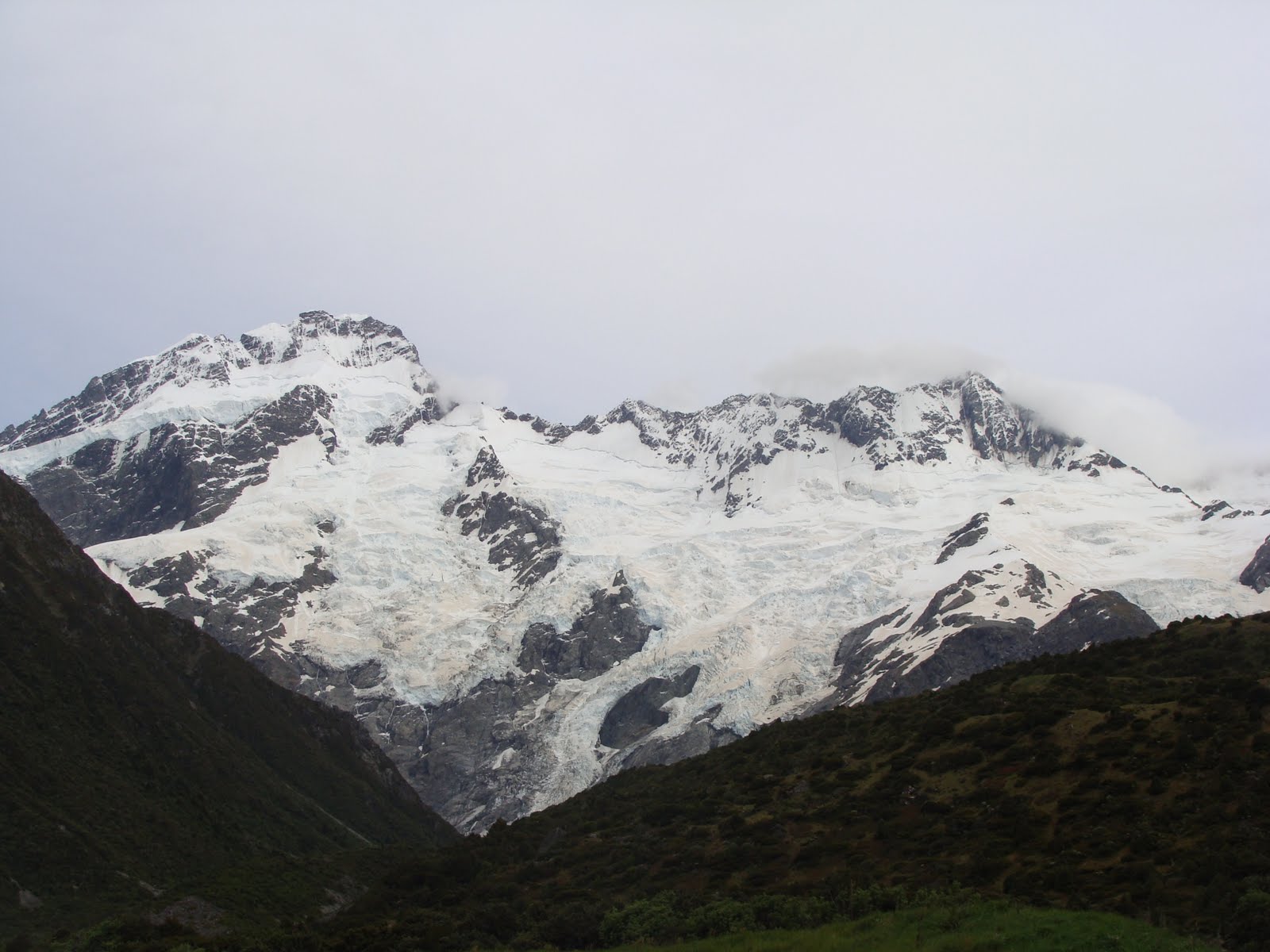
Early morning in The Aoraki/Mount Cook National Park, 25 December 2009

Dunedin is famous for the only mainland albatross breeding colony situated at the far end of the Otago Peninsula, some 30 minutes drive from the city. These awesome birds are endangered thanks to longline tuna fishing, amongst other things, and the Royal Albatross Colony is working hard to protect and preserve the species. Royal Albatrosses have a wingspan of up to 6 feet, and to watch them soar over the seacliffs at Taiaroa Head is a very special feeling indeed. Their chicks are the size of turkeys, and are all fluffy… cute in an ugly kind of way, but when you see what they mature into, it takes your breath away. Albatrosses glide, using thermals and wind currents to keep them aloft, they don’t flap their huge wings. They can, and do, spend months out at sea, only coming to land to breed. I felt privileged to watch these magnificent birds in the sky, seeing their clumsy landings and feeding their young.

Royal Albatrosses, Dunedin, New Zealand

The Christmas period was spent in Central Otago, at Lake Ohau – real Lord of the Rings country [yes, parts of the film were shot around here]! The average daily temperature was 30 degrees and we were camped beside a small kettle lake, Lake Middleton, sheltered away from the strong winds that race down Lake Ohau from the mountains. The lupins were in full bloom, snow still capped the mountains all around and the beautiful New Zealand birdsong completed the idyllic location. This was our base, and other than messing around in the lake with canoes and paddle boards, it was where we relaxed. Trips to the nearest town (for a shower!) were a major undertaking, especially with PSP-starved nephews, so it really was back to nature.

View from the campsite, Lake Middleton, New Zealand

The Aoraki/Mount Cook National Park is a harsh land of ice and rock, even at the height of summer. Glaciers cover 40% of it. There are 19 peaks over 3,000 metres, including Mount Cook, the highest peak in New Zealand at 3754 metres. [I think this is the highest mountain I’ve ever seen, but Everest is 8850m… over twice the height!]
“The glaciers that have helped shape the park's landscape include five major valley systems: Godley, Murchison, Tasman, Hooker and Mueller. The Tasman Glacier, New Zealand's largest and longest glacier, is clearly visible from the main highway at the entrance of the park”
We came here on Christmas morning to walk up to the foot of the Hooker Glacier, a 4-hour round hike. I saw my first avalanche while still in the car park, but as there was one every 3 or 4 minutes, the novelty soon wore off. I could see the huge cracks in the snow as the sun’s warmth destabilised the previous winter’s fall. The walk itself took us across the Hooker River, a fast glacial run-off flow rendered opaque by the quantities of rock dust carried within the water, and along the side of the valley where the glacier has retreated.

Crossing the Hooker River, it was very windy!

I was hoping to see some Keas, alpine parrots unique to New Zealand and famous for their cheeky antics, however, they had moved further up the slopes to avoid the summer heat. So I made do with admiring the ice-bergs in the moraine-dammed lake at the foot of the Hooker Glacier… they were very blue, and while not Antarctic sized, I was suitably impressed – this was ice, 1000’s of years old yet melting in the summer sun as part of the glacial retreat caused by rising temperatures planet-wide.

A long and lonely road...

I have been to New Zealand 5 times now, and never tire of visiting. The South Island is so very beautiful, with awe-inspiring scenery, dense temperate rain forest, and unique wildlife. It is sad that so many of the native creatures are in decline, mainly due to the interference of humans who brought cats, dogs, rats, stoats, rabbits and all kinds of other animals from ‘home’. These animals are now destroying the unique bird population, many of which are flightless. The Kakapo, a flightless parrot, last seen on TV with Stephen Fry and Mark Carwardine, is critically endangered and can only be found on a protected small island off the main NZ coast. The Kiwi, the national emblem, is also under pressure, with introduced small mammals feeding on their eggs. I find it shocking that these islands maintained a rich and thriving ecosystem for millennia, yet since the arrival of the first humans, some 600 years ago, began a destructive process that is getting harder each year to counteract. 

Enjoying the summer sunshine - December 2009


But it is difficult to think of the destruction of species and habitats when you are watching a Kahu (Australasian Harrier) wheel above the plains, circling around and then diving at some poor possum or rabbit in the distance. When the sun sets behind a range of snow-capped mountains, casting fiery streaks across the sky to reflect in the lakes below, I feel insignificant in comparison to the natural beauty all around me. Amazing landscapes, such as those in New Zealand, engender a feeling of peace within me, yet help me put my own issues and problems into perspective. 

How to spend Christmas 2009

As much as I love my books, and the worlds I inhabit within their pages, nothing compares to the feeling I get when surrounded by the power of nature. Whether it is the Irish Atlantic coast, with giant waves crashing against the cliffs, or India with it's deep red soil and white sandy beaches, or New Zealand in the clean mountain air, I will always have a deep respect for the beautyand richness our planet offers us. I only wish others felt the same way, instead of destroying our natural resources in the pursuit of profit.

Sunset over Lake Ohau
Credit: All photos were taken by my sister, Bronagh Quinn. I wonder has she read this yet?!

The Joy of the Omnibus

[First posted 21 March 2010]

There is little more pleasure in the world than settling down in a comfortable setting (a hammock on a tropical beach is ideal), with plenty of on hand sustenance (chocolate, salted pistachios or trail mix...), drink of choice and an omnibus edition of a favourite author. This is a format I hope will increase in popularity as it is a great way to read a trilogy. No more waiting for the author to complete the last book in the series; perfect for a range of speculative fiction. Win/win.

One of my favourite authors is Mark Chadbourn. I discovered his "Age of Misrule" trilogy when browsing through my local Waterstones 2 or 3 years ago. I had never heard of him nor seen any reviews of his book, but was reeled in by the first line of the blurb
All over the country, the ancient gods of Celtic mythology are returning to the land from which they were banished millennia ago.
What followed was 1350 pages of modern fantasy at it's finest. With white-knuckle action interspersed with passion, betrayal, tragedy and despair, the entire trilogy was a blast of fresh air into my stale reading life. With the Brothers and Sisters of Dragons I travelled the length and breadth of Britain, through the lands of the Tuatha de Danaan to a dramatic conclusion that spoke of much more to come. The Age of Misrule is the first of 3 trilogies by Mark Chadbourn, The Dark Age and Kingdom of the Serpent completing the set. He released The Silver Skull, the first of an Elizabethan trilogy in November 2009.

I found another favourite author in 2005 by way of an omnibus edition of the first 3 books in her Black Jewels series. Anne Bishop has created a three-tier world populated with different races... the long-lived Hayllians, Eyrians; dark magic, demon-dead, witches, and of course, The Blood. The darker the jewel, the more powerful the magic the holder possesses.
Ancient prophecies have foretold the coming of a powerful witch, one who would in reality be not a mere human female but "dreams made flesh," nothing short of Witch herself.
This is adult fantasy, exploring the evil of sexual abuse is not usual fantasy fare, however, it is very sensitively handled here. And in a society where women are the ruling Queens and men of The Blood serve, there is no shortage of violence, revenge and corruption. Jaenelle is the focus of the trilogy and is a sympathetic and well constructed character. I am currently reading number 7 in the series, Shalador's Lady, and am still not tiring of Anne Bishop's Black Jewels world.

At last Anne Rice's The Vampire Chronicles is released in omnibus format and it is in my shopping basket as an easter treat to myself. Less calories than a Lindt Lindor easter egg too! I first read Interview with a Vampire in the early 80's, during my Goth phase, and both loved and loathed Lestat in equal measures. I read all her subsequent novels too, my favourites being Queen of the Damned and The Witching Hour. The first line of Queen of the Damned sums up the central character
I'm the Vampire Lestat. Remember me? The vampire who became a super rock star, the one who wrote the autobiography? The one with the blond hair and the blue eyes, and the insatiable desire for visibility and fame? You remember.
Some of Anne Rice's best writing is contained within The Vampire Chronicles and she brought fresh blood to an ailing horror standard. Anyone who likes Twilight should read this... real vampires are NOT vegetarian. They are devious, totally self-centred and morally corrupt, as befits the legend handed down from Bram Stoker.

So *publishers take note* an omnibus edition could be a way to revitalise a back catalogue. The SF and Fantasy Masterworks series were lovely and worth collecting, but many of those books are available in several reprints. Let's face it, your target audience has got most of them anyway, so why not look back on what you have in single book format and create an omnibus edition series or imprint? A few suggestions off the top of my head that I think would be suitable for publishing as an omnibus are:
  • Kim Stanley Robinson - Forty Signs of Rain, Fifty Degrees Below, Sixty Days of Counting
  • Raymond E. Feist & Janny Wurts - The Empire trilogy (Servant of the Empire, Daughter of the Empire, Mistress of the Empire)
  • Faith Hunter - Rogue Mage novels (Bloodring, Seraphs, Host)
  • Anne Bishop - Tir Alainn series (The Pillars of the World, The Shadows and the Light, The House of Gaian)
  • Maria V. Snyder - The Study trilogy (Poison Study, Magic Study, Fire Study)
Thanks to Victoria Rogers for giving me the idea for this post... omnibus editions are the way to go.

Books and Me!

[Posted 28 February 2010]

I always carry a book with me wherever I go. You never know when you might need one! On the tube, waiting around, eating lunch in the park (weather permitting)... there are opportunities to read everywhere. And I like to make the most of any opportunities that arise.

So when did this reading habit begin? To be honest, I cannot remember NOT reading by myself. I was a competent reader before I started school, and, much to the dismay of the teacher, was unwilling to accept books with large pictures and only 4 or 5 words per page. Janet & John did not go down well with me - I preferred mythical heroes and dark fairy stories! I think I read the entire set of Andrew Lang's Fairy Books before the age of 8 or 9 and Celtic, Norse or Greek myths were also firm favourites. Then I discovered Narnia... a life-long love of Fantasy was born.

Through my teens I read Anne McCaffrey: The Ship Who Sang, the Pern novels and the Talents series. A firm favourite was Z for Zachariah by Robert O'Brien, through which I discovered post-apocalyptic fiction. Granted I also had an Enid Blyton and Elinor M. Brent-Dyer boarding school phase, but given I grew up in Northern Ireland during the troubles, that was a fantasy world too! Many of the books I read back then were considered 'boy's books' and so I had 'issues' with most of the books selected for study at school. Some, like To Kill A Mockingbird and The Diary of Anne Frank became firm favourites but the majority I can barely remember what they were.

The one area where my convent education has fallen down is with regard to classic literature. The set texts chosen for O Level English Literature included 'Villette' by Charlotte Bronte, 'The Trumpet Major' by Thomas Hardy and Shakespeare's 'The Taming of the Shrew'. I hated them all and got a grade U (unclassified) for slagging them off in the exam! The net result being that now I avoid 'classic' literature wherever possible... no, I haven't read Pride and Prejudice, Wuthering Heights or Tess of the D'Urbervilles. The TV series versions suit me just fine! And I don't feel like I am missing out either... overly descriptive writing getting in the way of a good story, in my view.

It was at college that I was introduced to science fiction proper. I was reading a lot of Stephen King, James Herbert and Clive Barker at the time, when a boyfriend gave me a copy of Stranger in a Strange Land by Robert A Heinlein, mainly because I was a massive U2 fan, and the title was a favourite track on the October album. I loved it, and still have that original copy today. Aldous Huxley's Brave New World, Margaret Atwood's A Handmaid's Tale and The Day of the Triffids by John Wyndham soon followed. These books could be considered dystopian fantasy rather than sci-fi per se, and this is the direction I have followed ever since. I don't like 'hard' sci-fi with overly complex technology or space battles. I didn't get on with Larry Niven's Ringworld or The Forever War by Joe Haldeman. Cyberpunk passed me by in favour of more feminist writers like Ursula Le Guin, Sherry Tepper, and Octavia Butler. I chose to read Marion Zimmer Bradley, Joan D Vinge and Katherine Kerr over Neal Stephenson, Iain M Banks or William Gibson. And these trends continue today.

While I admit to a preference for female authors such as Jacqueline Carey and Anne Bishop (and a guilty love of urban fantasy and paranormal romance!), there are new male writers coming through today that appeal to me and my taste in reading. Mark Chadbourn's Age of Misrule trilogy and Chris Wooding's The Braided Path are two fairly recent examples. Towards the end of 2009 I read Mark Charon Newton's Nights of Villjamur, it being highly recommended by various book bloggers (and the author himself!) who I 'met' through Twitter. This, combined with meeting lots of similar 'book people' on Twitter, has opened a new world of up and coming writers of quality fantasy for me. A new publishing house, Angry Robot Books, has released a wave of new talent in the world of speculative fiction and horror.

I have a TBR pile that currently has some 50 books in it, plus a list of pre-orders on amazon that would scare my bank manager! New male authors like Blake Charlton, Sam Sykes, and Stephen Deas are battling for shelfspace with new female writers such as Kaaron Warren, Aliette de Bodard and N.K. Jeminsin. I no longer wander round the Kingston branch of Waterstones (huge SFF section!) selecting books on the basis of the blurb on the back cover, but instead am more informed by reading book blogs written by friendly people who share my tastes. Sadly it is all too easy to use the "One-Day 1- Click" button on amazon and find the book(s) discussed on Twitter on my doorstep when I get home from work the next day!

Some great book review blogs (in no particular order)